MERIT-RPPROJECT DETAILS
Energy-Efficient and Secure Wireless Sensor Network Routing
Research · Reinforcement Learning · Network Engineering
Project Overview
A research-oriented routing protocol addressing energy efficiency, security and routing reliability in dynamic wireless sensor networks through adaptive network control and reinforcement learning.
Problem & Solution
Sensor nodes have limited energy, while changing links and untrusted relays make reliable routing difficult. Relay selection must consider several competing objectives.
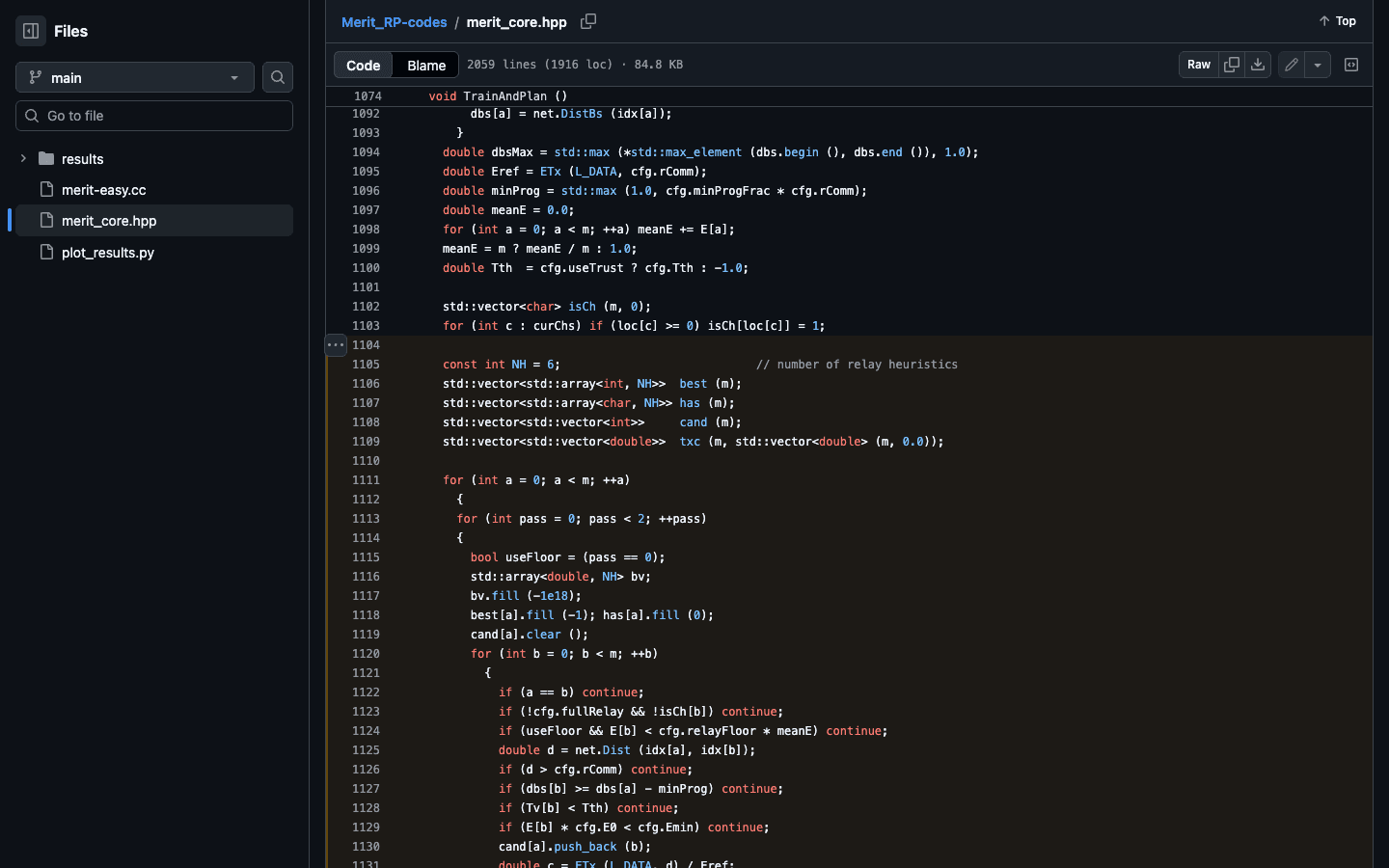
Combine adaptive clustering and network control with sink-side tabular Q-learning to plan constrained relay paths using energy, trust, link stability and transmission cost.
Key Features
- Sink-side relay planning
- Energy- and trust-aware relay selection
- Adaptive clustering and network control
- Routing-hop and relay-load constraints
Technical Implementation
The default configuration divides the network into 25 spatial cells and three residual-energy buckets, producing 75 discrete states.
Seven actions represent six forwarding heuristics—progress, energy, trust, link stability, transmission cost and a balanced heuristic—plus direct transmission to the sink.
The multi-objective reward accounts for transmission cost, residual energy, trust and link stability, with potential-based reward shaping.
Decaying epsilon-greedy exploration is used with 400 training episodes per planning round.
The routing planner uses a six-hop planning constraint and a relay-load limit of three planned flows per relay.
My Contributions
- Design and implementation contributions to Q-learning-based relay planning, state-action formulation, reward engineering, learning configuration and constrained routing decisions.
Engineering Considerations and Limitations
- A central engineering challenge is balancing energy cost against trustworthy, stable relay choices within a compact state space.
- These are implementation details, not claims of experimentally established performance improvements.